Facing a blank page when writing your first resume is a daunting experience. When a job description asks for a resume, it is easy to assume they are exclusively looking for a chronological list of paid, corporate job titles. However, hiring managers recruiting for entry-level positions or internships are well aware that recent graduates and career transitioners will not have a long corporate history. Instead of looking for a decade of formal experience, recruiters are looking for evidence of trainability, foundational skills, and a strong work ethic.
Official Source: https://www.careeronestop.org/JobSearch/Resumes/resumes.aspx
You already possess the raw materials necessary to build a compelling resume; you simply need to reframe how you present your life experiences. By strategically prioritizing your education, detailing your academic projects, and treating your volunteer work or extracurricular activities with the same respect as a paid job, you can create a one-page document that easily passes Applicant Tracking Systems (ATS) and impresses hiring managers.
Official Source: https://www.indeed.com/career-advice/resumes-cover-letters/resume-with-no-experience
Step 1: Write a Targeted Professional Summary
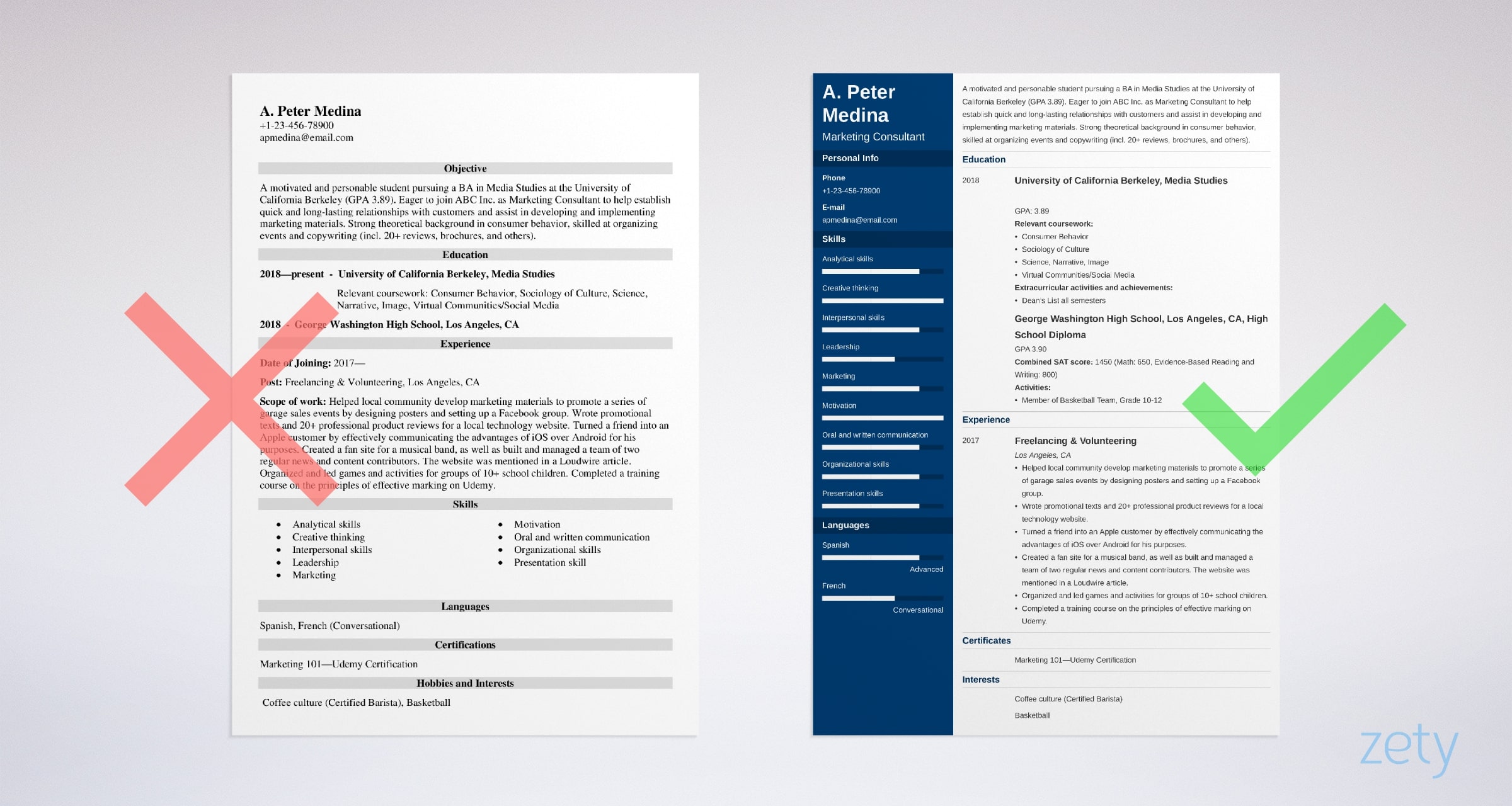
When you have no work experience, you cannot rely on past job titles to hook the recruiter’s attention. Instead, use the top of your resume to feature a Professional Summary. This replaces the outdated “Objective Statement.” A summary is a concise, three-sentence paragraph that immediately communicates your current status, your strongest hard skills, and the specific value you want to bring to the employer.
Official Source: https://www.indeed.com/career-advice/resumes-cover-letters/writing-a-resume-summary-with-examples
For example, instead of writing “Seeking a job in marketing,” write: “Detail-oriented Communications graduate with a 3.8 GPA and academic experience in digital content creation and data analytics. Proven ability to manage complex project schedules and lead peer groups. Eager to apply SEO and copywriting skills to support the digital marketing team at [Insert Company Name].” This approach immediately establishes your professional tone and targets the specific role.
Official Source: https://www.careeronestop.org/JobSearch/Resumes/ResumeGuide/Introduction.aspx
Step 2: Maximize Your Education Section
For traditional job seekers, the Education section sits at the very bottom of the resume. When you lack work experience, your Education section must move to the very top, immediately below your Professional Summary. This is your primary credential. Do not simply list your university or high school name and graduation year; expand this section to demonstrate your active participation and academic success.
Official Source: https://www.careeronestop.org/JobSearch/Resumes/resume-tips.aspx
Include your GPA if it is above 3.5. Add a “Relevant Coursework” subsection and list four to six upper-level classes that directly relate to the job you are applying for. If you are applying for a financial analyst role, listing courses like “Advanced Macroeconomics,” “Statistical Modeling,” and “Corporate Accounting” proves you possess the foundational knowledge required for the job, even if you have never been paid to do it. Include any academic honors, Dean’s List appearances, or study abroad programs here as well.
Official Source: https://www.indeed.com/career-advice/resumes-cover-letters/education-on-resume
Step 3: Treat Extracurriculars and Volunteer Work Like Jobs
Unpaid work is still work. Managing the budget for a university club, organizing a local charity run, or serving as the captain of a sports team requires leadership, time management, and problem-solving. Create a section titled “Leadership & Volunteer Experience” and format these roles exactly as you would a traditional job.
Official Source: https://www.linkedin.com/business/talent/blog/talent-acquisition/how-to-optimize-your-resume-for-ats
List your title (e.g., “Event Coordinator” or “Club Treasurer”), the organization name, and the dates of your involvement. Beneath that, use three bullet points starting with strong action verbs to describe what you accomplished. Instead of writing “Helped with the club budget,” write: “Managed a $5,000 annual budget, allocated funds for three major campus events, and maintained detailed financial records.”
Official Source: https://hbr.org/2021/07/how-to-write-a-resume-that-stands-out
Step 4: Create an Academic or Personal “Projects” Section
If you do not have volunteer experience, a dedicated “Projects” section is the most powerful tool for an entry-level resume. This is especially critical for technical roles, engineering, writing, or graphic design. Think of the most difficult, long-term assignment or capstone project you completed in school, or a personal passion project you built in your free time.
Official Source: https://www.careeronestop.org/JobSearch/Resumes/customize-your-resume.aspx
Format the project clearly: include the Project Title, your specific role, and the dates. Use bullet points to explain the objective of the project, the specific software or methodologies you used, and the final outcome. For example, if you built a basic website for a class, detail the coding languages used (HTML/CSS), the design process, and the final grade or reception. This proves you have practical, hands-on experience applying the theories you learned in class.
Official Source: https://www.indeed.com/career-advice/resumes-cover-letters/resume-with-no-experience
Step 5: Build a Concrete Skills Section
A strong skills section allows Applicant Tracking Systems (ATS) to read your resume and match you to the job description. Separate your skills into two distinct categories: Hard Skills (technical abilities, software proficiency, foreign languages) and Soft Skills (communication, conflict resolution, time management).
Official Source: https://www.careeronestop.org/JobSearch/Resumes/resume-tips.aspx
Be as specific as possible with your hard skills. Instead of just writing “Computers,” write “Microsoft Excel (VLOOKUP, Pivot Tables), Adobe Photoshop, Python.” Always read the employer’s job description closely and mirror their exact phrasing in your skills section. If they ask for “Client Relations,” ensure that exact phrase appears on your resume.
Official Source: https://hbr.org/2014/12/how-to-write-a-resume-that-stands-out
Safety Warnings: What to Avoid
When writing an entry-level resume, never lie or exaggerate your experience to fill space. Claiming you are an “expert” in a software program you only used once will inevitably backfire during a technical interview. Do not pad the document with generic, irrelevant hobbies (like “watching movies” or “hanging out with friends”), as this looks unprofessional. Finally, ensure your contact information uses a strictly professional email address—ideally a combination of your first and last name (e.g., john.smith@email.com)—rather than an outdated or inappropriate personal handle.
Official Source: https://www.indeed.com/career-advice/resumes-cover-letters/what-not-to-include-on-a-resume
Frequently Asked Questions (FAQ)
How long should my resume be if I have no experience?
Your resume must be strictly limited to one page. Even professionals with ten years of experience are often advised to keep their resumes to a single page. If your entry-level resume is spilling over onto a second page, you have likely included too much irrelevant filler or your formatting margins are too wide.
Official Source: https://www.careeronestop.org/JobSearch/Resumes/resume-tips.aspx
Should I use a functional or chronological resume format?
If you have absolutely no formal work history, a functional (or hybrid) resume format is usually better than a strict chronological one. A functional format focuses heavily on your skills, projects, and educational achievements rather than a timeline of past employers. However, ensure that any projects or volunteer roles you list still include dates to show your timeline of activity.
Official Source: https://www.careeronestop.org/JobSearch/Resumes/resumes.aspx
Do I still need a cover letter?
Yes, a cover letter is essential when you lack work experience. The cover letter provides the narrative space to explain why you are applying for the job, your passion for the industry, and how your academic background uniquely prepares you for this specific role. It allows you to showcase your personality and drive in a way that a bulleted resume cannot.
Official Source: https://hbr.org/2014/02/how-to-write-a-cover-letter
C. Verified Direct Official Sources
-
Source Title: Resumes – Getting Started
-
Publisher: CareerOneStop (Sponsored by the U.S. Department of Labor)
-
Direct URL:
https://www.careeronestop.org/JobSearch/Resumes/resumes.aspx -
What the Source Supports: Explains the foundational purpose of a resume for entry-level candidates, confirming that potential and foundational skills are valid substitutes for corporate history.
-
Verification Status: Verified direct official US Department of Labor documentation URL.
-
-
Source Title: How To Write a Resume With No Experience
-
Publisher: Indeed Career Guide
-
Direct URL:
https://www.indeed.com/career-advice/resumes-cover-letters/resume-with-no-experience -
What the Source Supports: Provides the structural framework for highlighting academic projects, listing relevant coursework, and formatting volunteer work as professional experience.
-
Verification Status: Verified direct official Indeed documentation URL.
-
-
Source Title: How to Write a Resume That Stands Out
-
Publisher: Harvard Business Review
-
Direct URL:
https://hbr.org/2021/07/how-to-write-a-resume-that-stands-out -
What the Source Supports: Details the importance of action-oriented bullet points, concrete achievements over vague duties, and maximizing the Professional Summary.
-
Verification Status: Verified direct official Harvard Business Review URL.
-
-
Source Title: Resume Tips
-
Publisher: CareerOneStop (Sponsored by the U.S. Department of Labor)
-
Direct URL:
https://www.careeronestop.org/JobSearch/Resumes/resume-tips.aspx -
What the Source Supports: Outlines hard formatting rules, including keeping the entry-level resume to exactly one page and ensuring a professional email address is used.
-
Verification Status: Verified direct official US Department of Labor documentation URL.
-